
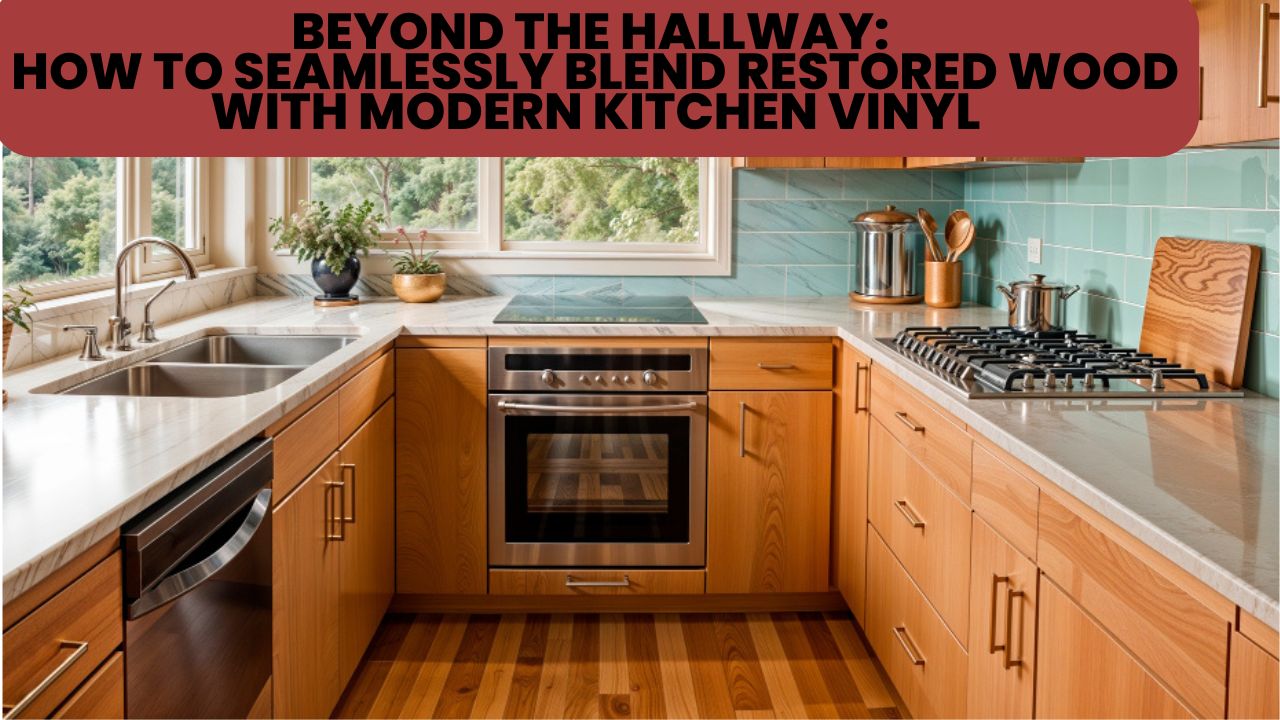
Stepping from a draughty Victorian hallway into a bright, modern kitchen is a classic London transition, but the floor underfoot often tells a disjointed story. Many of our clients at Floor Direct Ltd face a specific challenge: they’ve uncovered beautiful original pine or oak boards in the lounge, but they need something far more resilient for the splash zone of a busy kitchen.
Bridging the gap between the two isn’t just about picking colours; it’s about managing heights, textures, and the physical break between two very different materials. Take a look at how restored wood can be seamlessly blended with modern vinyls.
- Levelling the Subfloor Heights
The biggest mistake that people make when doing their own renovation is forgetting a step. The original floorboards are likely to be thicker than the vinyl flooring that you have today.
At Floor Direct Ltd, we overcome this problem by using high-quality plywood or smoothing compounds in the kitchen area before installing your vinyl flooring for kitchens. This raises the kitchen subfloor to the exact height of your sanded boards, eliminating the need for bulky, trip-hazard clamshell transitions.
- Choosing a Complementary Palette
Instead of attempting to match your wood with a vinyl that has a similar look, which tends to end up in a clash of grain patterns, we would suggest a Natural Contrast scheme. If the process of floor sanding & restoration in London has uncovered a warm, honey-colored pine, why not contrast this with a cool slate grey or a Moroccan design vinyl in the kitchen area?
This is a deliberate architectural division. At Floor Direct Ltd, we help you pair these textures in our Essex Road showroom so you can see how the light hits both surfaces before you commit.
- The Professional Hidden Join
A smooth merge is solely dependent on the threshold. Rather than a cheap plastic strip, we employ low-profile T-bars or brass Z strips that lie flat on both the wood and the vinyl.
In some of our more upscale renovation projects in London, we actually employ a caulked transition, where a thin line of flexible, colour-matched sealant fills the gap. This allows the wood to expand and contract without creating a gap between the wood and the kitchen floor.
At Floor Direct Ltd, we like to think that the character of your home doesn’t have to be compromised for functionality.
Are you ready to close the gap between your period details and a modern kitchen? Come and see us at 208 Essex Road or contact us on 0208 616 0508.